EOS — AI for Law Enforcement
Designing an explainable AI tool to support investigators working with large-scale video evidence
Project Info
6 Weeks
Group Project
Umeå Institute of Design
Group Members
Aditi Singh
Liu Hu
Moritz Nussbaumer
Focus
Interaction Design for
Specialized Users
Ethnographic Research Methods
Collaborators
Europol Innovation Lab
Swedish Police Authority
Context
The Europol Innovation Lab has developed a video analysis tool that uses computer vision (CV) and retrieval-augmented generation (RAG) technologies to enable keyword or image searches within video material. As part of a project at Umeå Institute of Design, this project proposes how interaction design informed by field research improves the usability, clarity, and trustworthiness of a video analysis tool for investigators.
Problem Space
Law enforcement investigators increasingly work with vast volumes of video evidence—from CCTV, body-worn cameras, and mobile phones. While AI technologies such as CV and RAG can support searching and filtering this material, they also introduce critical challenges around trust, transparency, and accountability.
Investigators remain legally and professionally responsible for their conclusions. As a result, systems that are opaque, overly automated, or difficult to interrogate risk undermining trust rather than supporting investigative work.
Solution
Eos is a conceptual AI-supported video analysis tool with interconnected workspaces designed for law enforcement investigators. The project explores how interaction design can support efficient video analysis while maintaining clarity, accountability, and trust in high-stakes investigative contexts through contextual prompting and system reasoning panels.
EOS Concept Video
Field Research with Investigators
This project followed a research-through-design methodology, treating research activities not only as inputs to design, but as opportunities to surface assumptions, values, and practices related to trust.
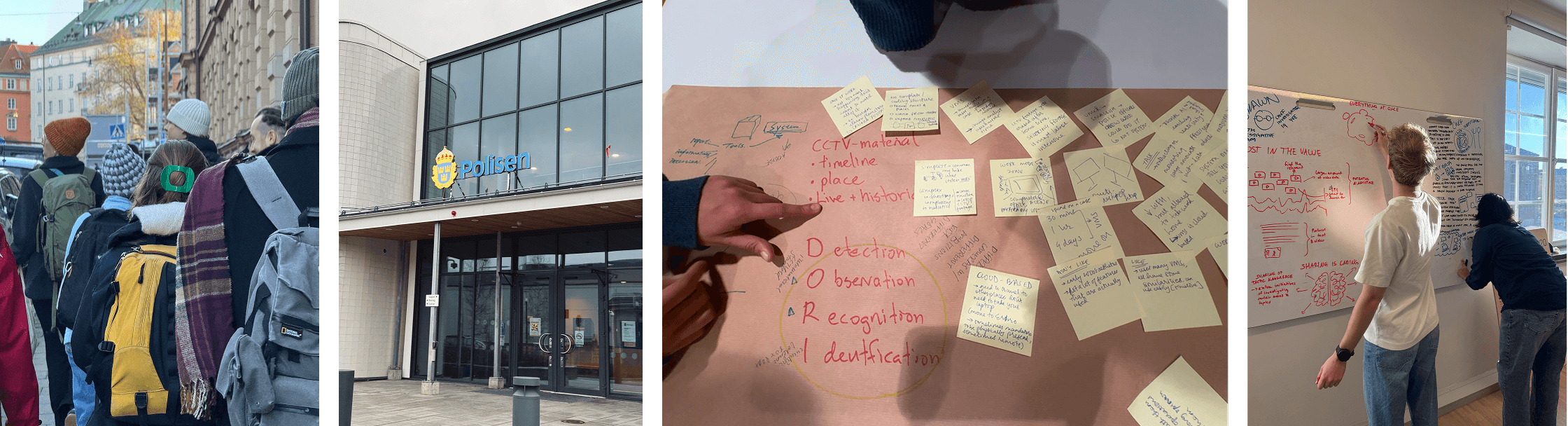
To ground the design in real investigative work, we interviewed 10 law enforcement investigators in Umeå and Stockholm and examined how video evidence is currently handled in practice. We looked at:
How they search, review, and compare evidence
How they move between overview and detail
Where uncertainty and judgment play a role
How accountability affects tool usage
We extracted stories from our interviews that became the central to our concept design phase. Their stories revealed that investigators place trust in tools that:
Align with their existing analytical practices
Use familiar visual structures and language
Allow them to scrutinise and justify decisions
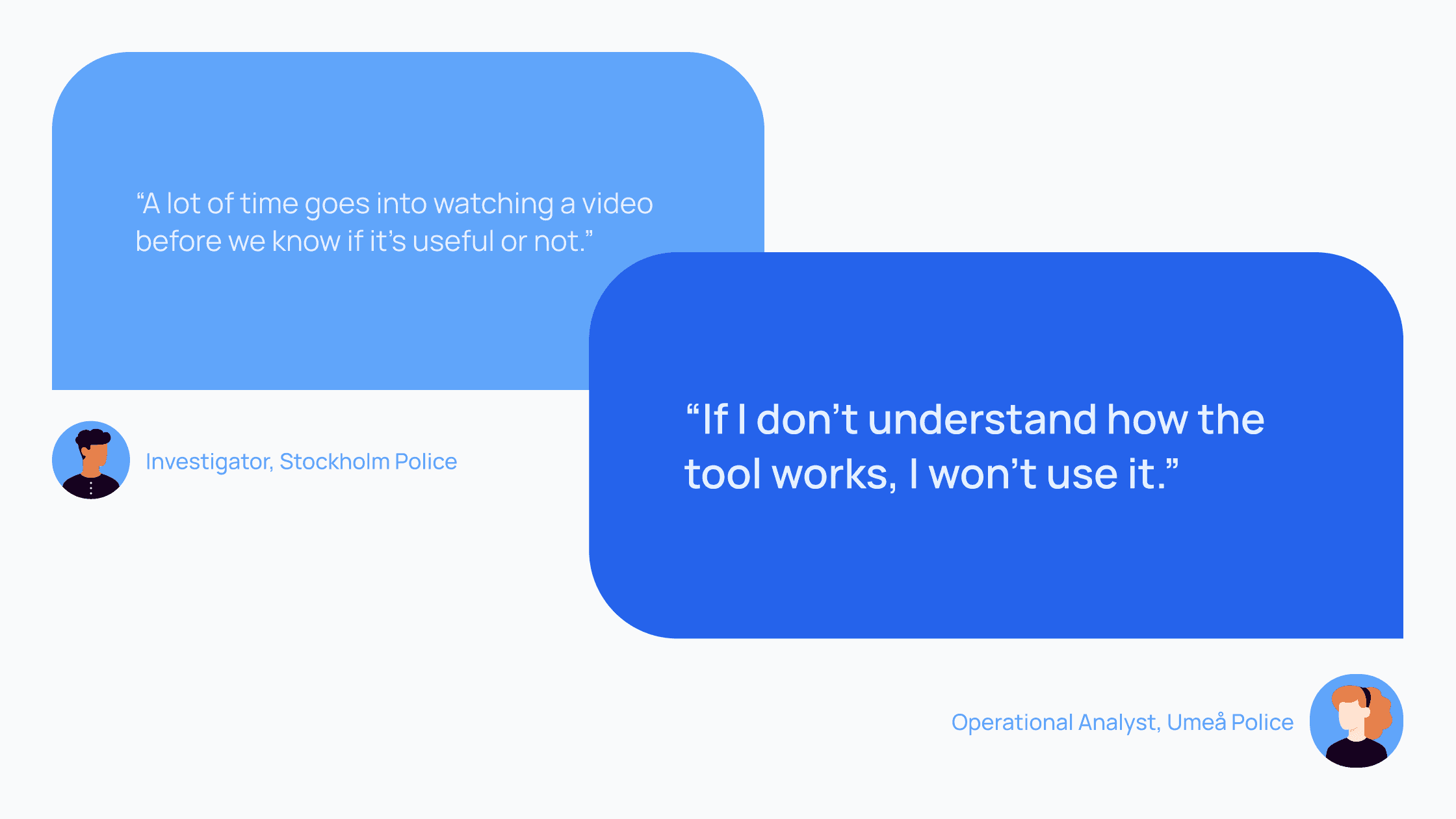
Quotes from interviews
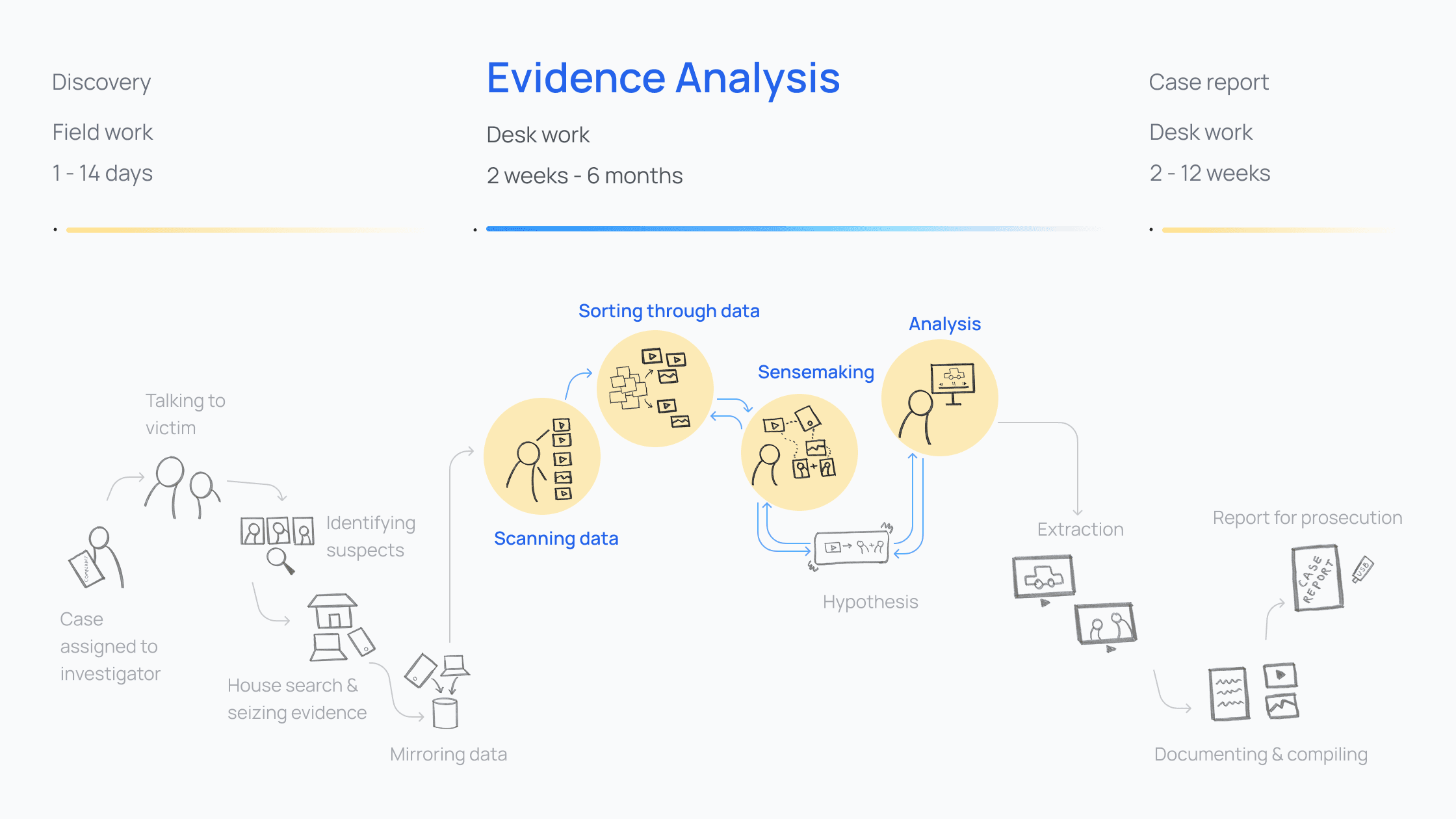
The sequence and timeframe of an investigation, with video evidence analysis in focus
Key Insights
Investigative Work Is Iterative and Non-Linear
Video evidence analysis unfolds over weeks or months and involves repeated cycles of scanning, sorting, sensemaking, hypothesis formation, and deep analysis. Investigators need tools that support iteration, backtracking, and evolving lines of inquiry.
Design Consideration
Create flexible workspaces that support switching between overview, sensemaking, and analysis.
Trust Depends on Being Able to “Check the Work”
Investigators are reluctant to rely on system outputs they cannot interrogate or justify, especially given potential legal scrutiny. Trust depends on making system actions visible, traceable, and understandable.
Design Consideration
Expose AI steps, data sources, and prompt histories directly in the interface.
AI Should Support, Not Conclude
Investigators emphasized that tools should assist exploration and pattern recognition, not generate conclusions autonomously. Maintaining human agency is essential.
Design Consideration
Design AI interactions that support inquiry and exploration rather than final answers.
Design Framework
Workspace-Based Structure
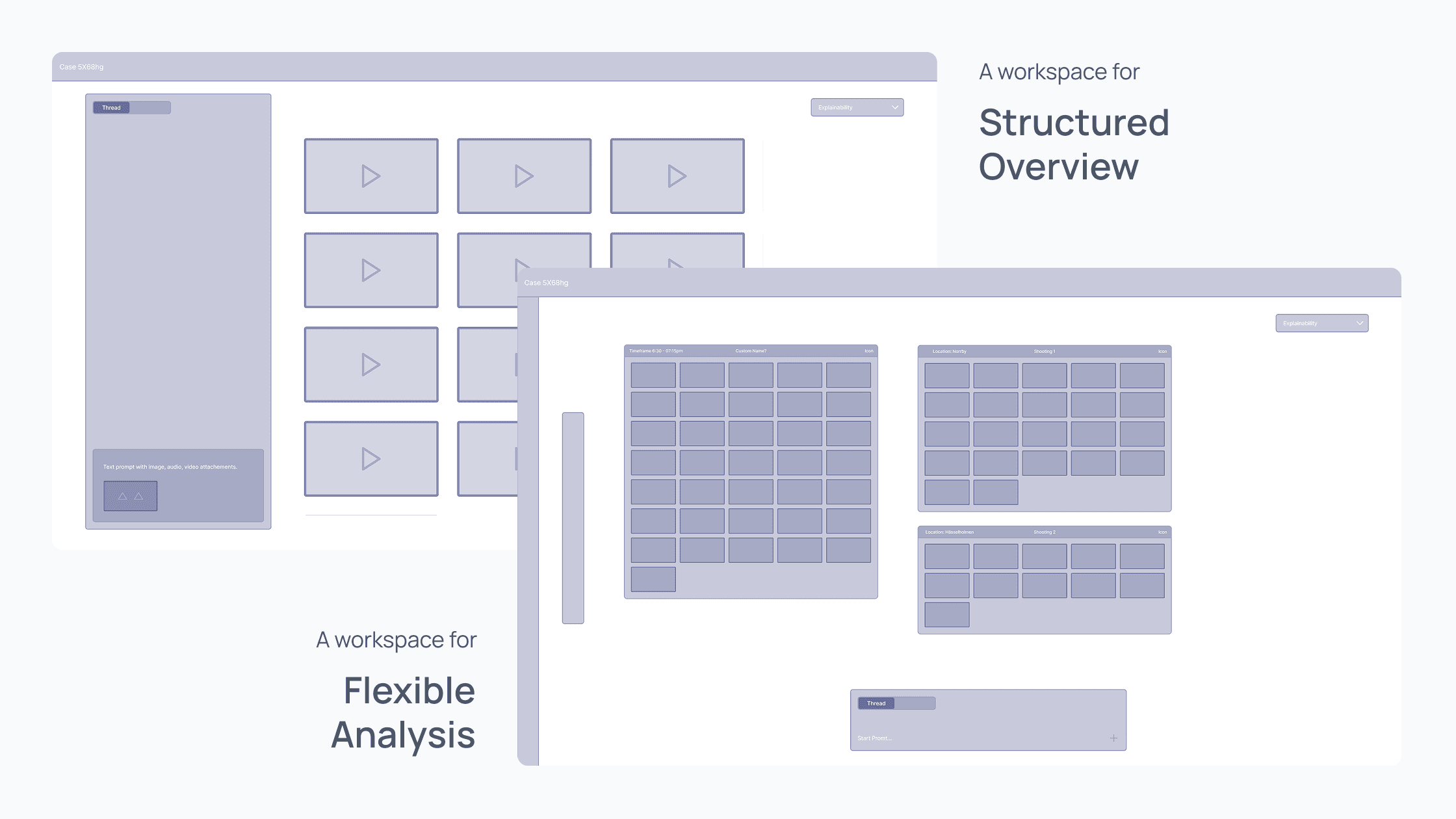
Separate the interface into distinct workspaces for overview and analysis to support the non-linear nature of investigative work, including a freeform space for connecting and organizing evidence in ways that match individual investigative styles.
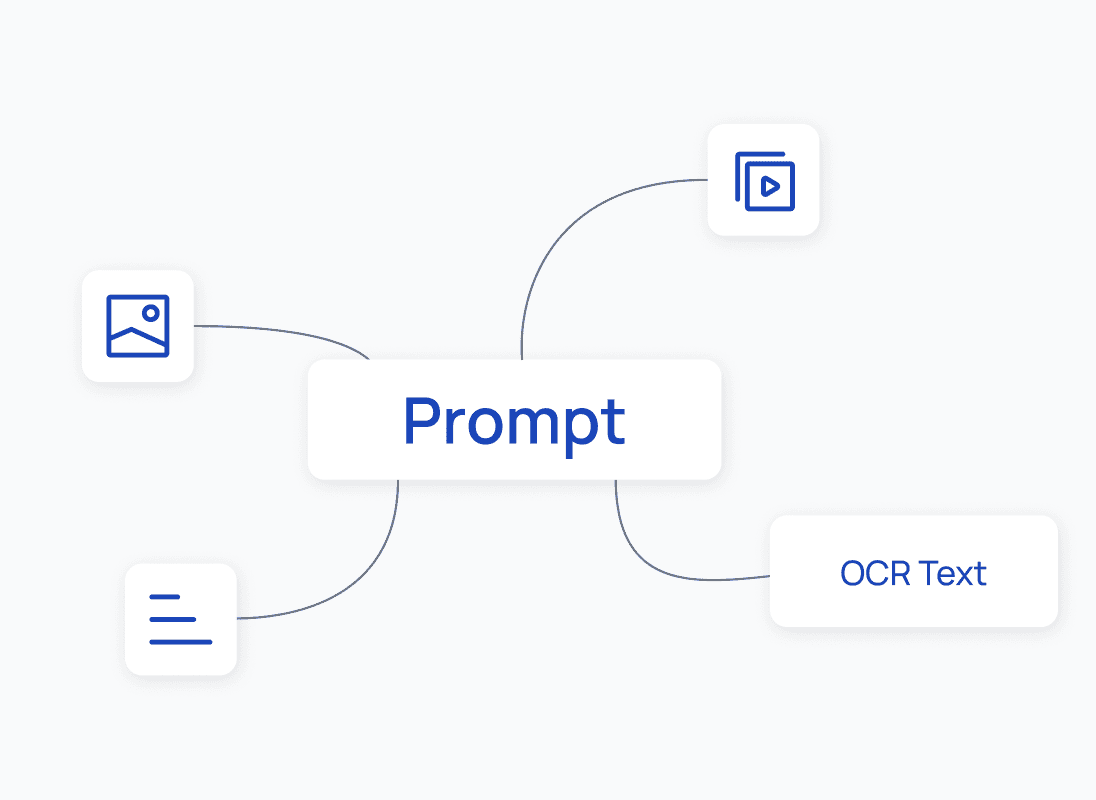
Prompting as Ongoing Interaction
Treating AI prompting as an ongoing multimodal interaction with traceable steps rather than a one-off search action, as investigative questions evolve over time, and results need context.
Built-In Explainability
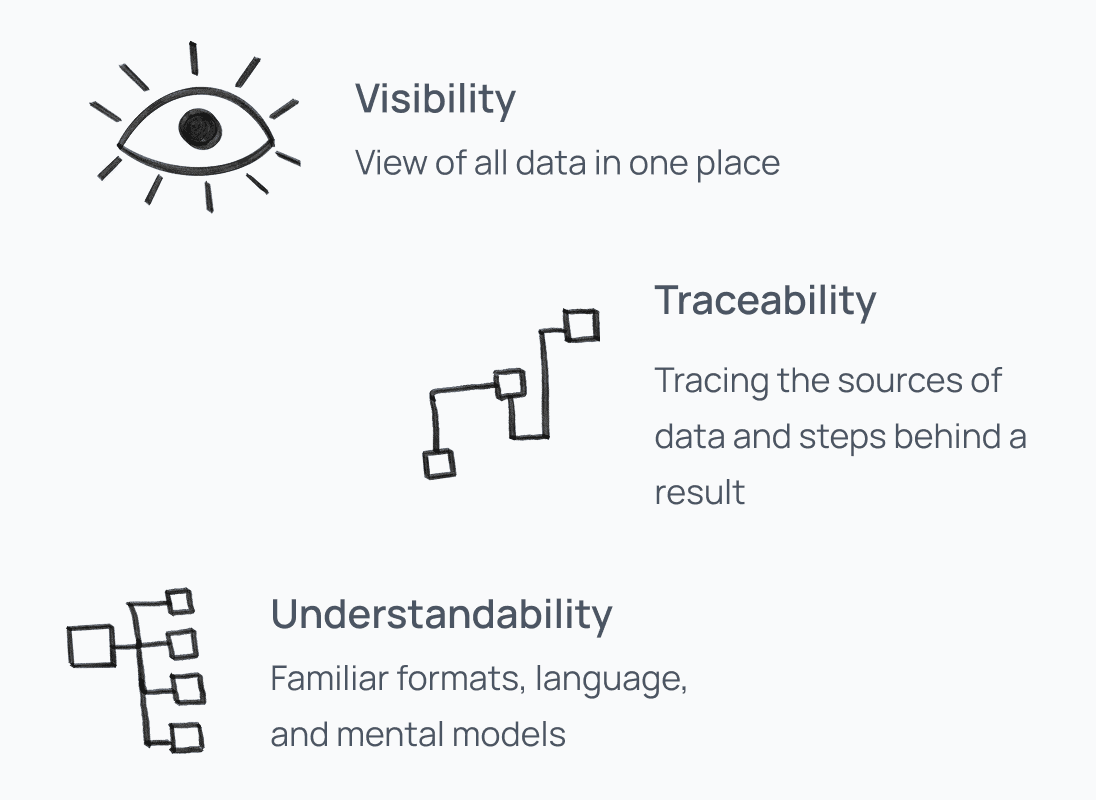
To make the AI system’s reasoning apparent to the investigator we defined explainability as having three qualities: visibility, traceability, and understandability.
Visual Design
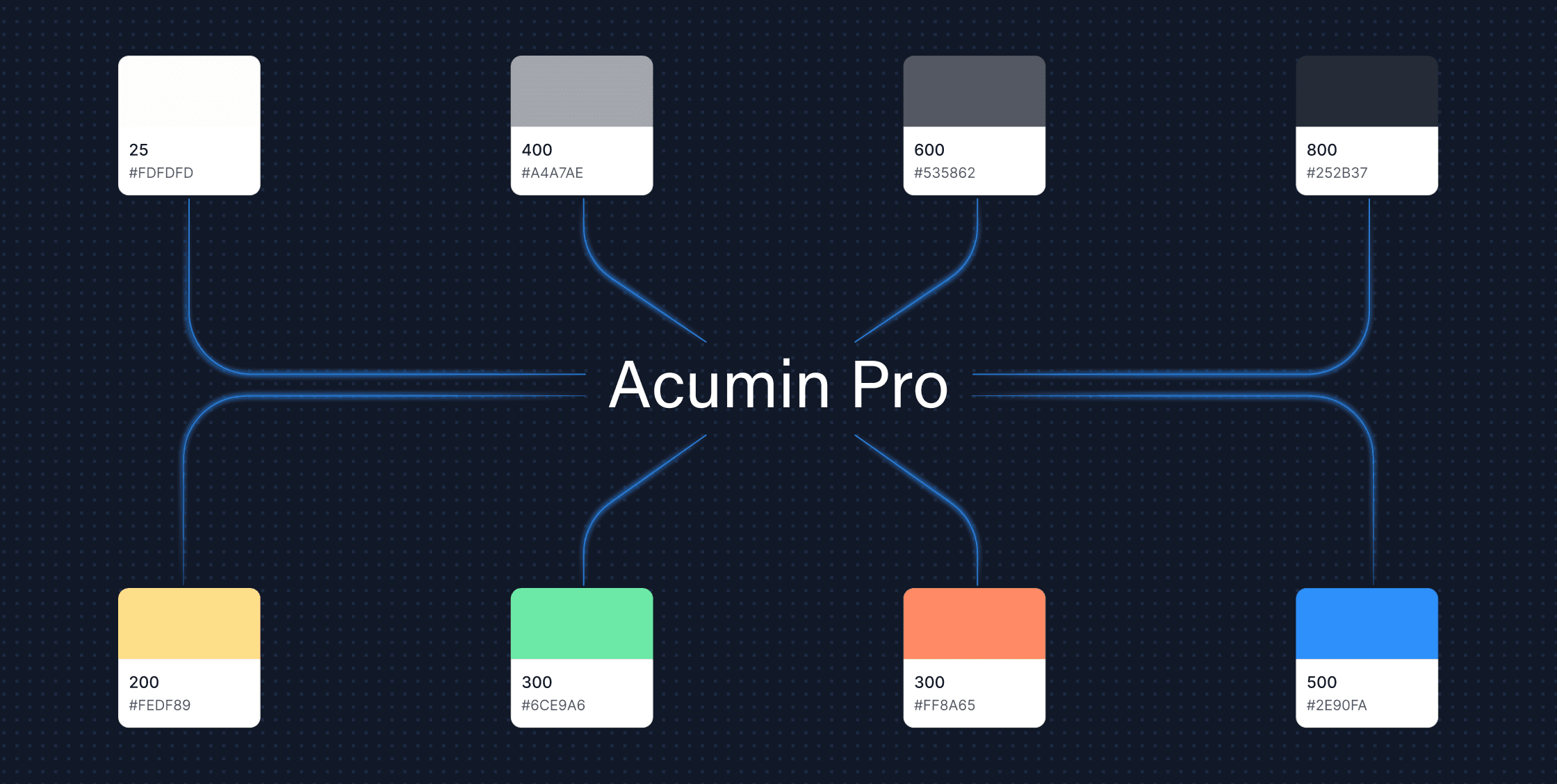
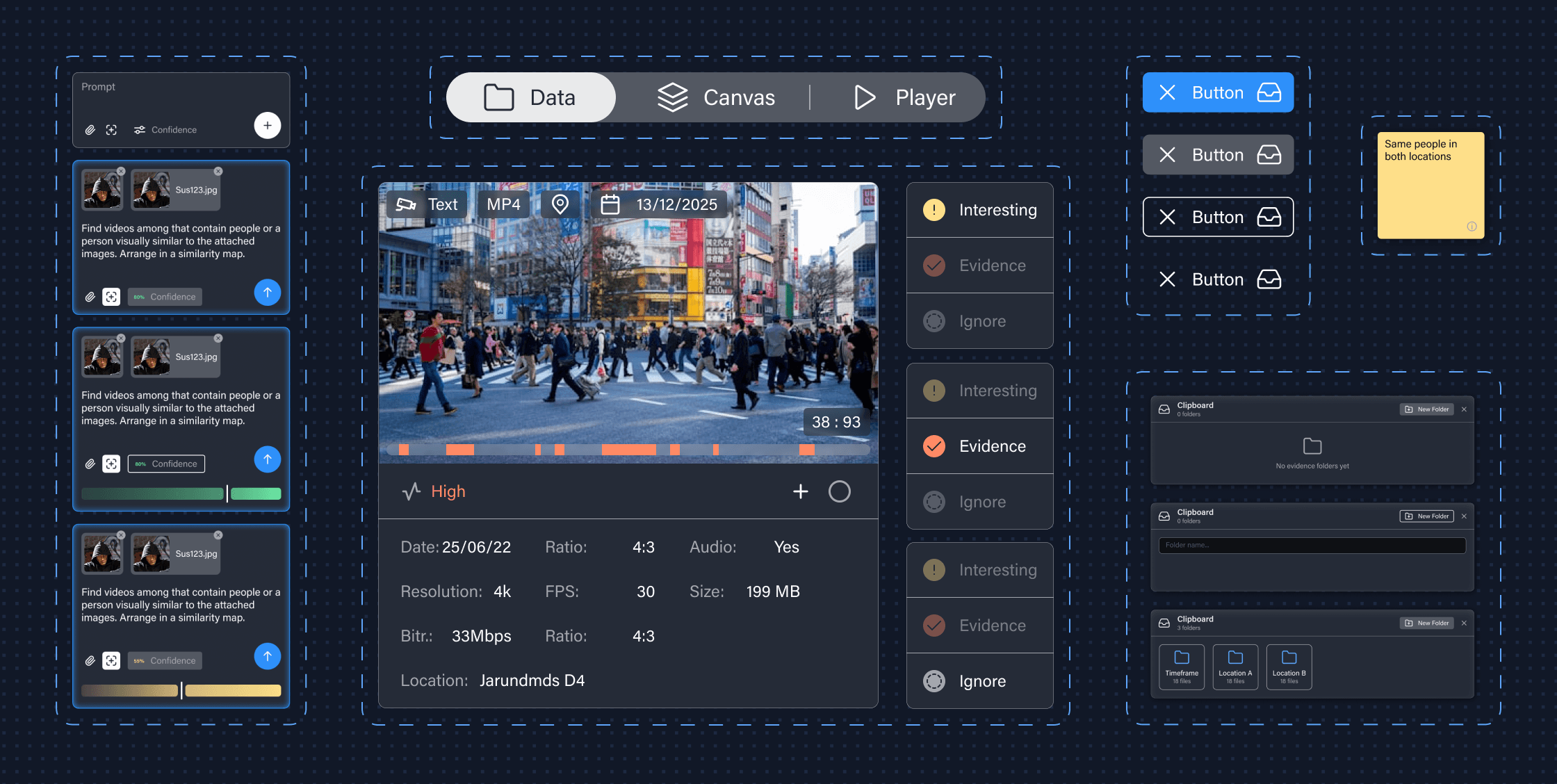
Eos uses a restrained dark mode visual language to support prolonged analytical work and reduce visual fatigue. A neutral colour palette and clear typographic hierarchy keep focus on video content and evidence, while accent colours are used sparingly to indicate system states, confidence levels, and investigative relevance.
Final Outcome
Eos is structured as a multi-workspace system that supports different phases of video evidence analysis while maintaining continuity across the investigation.
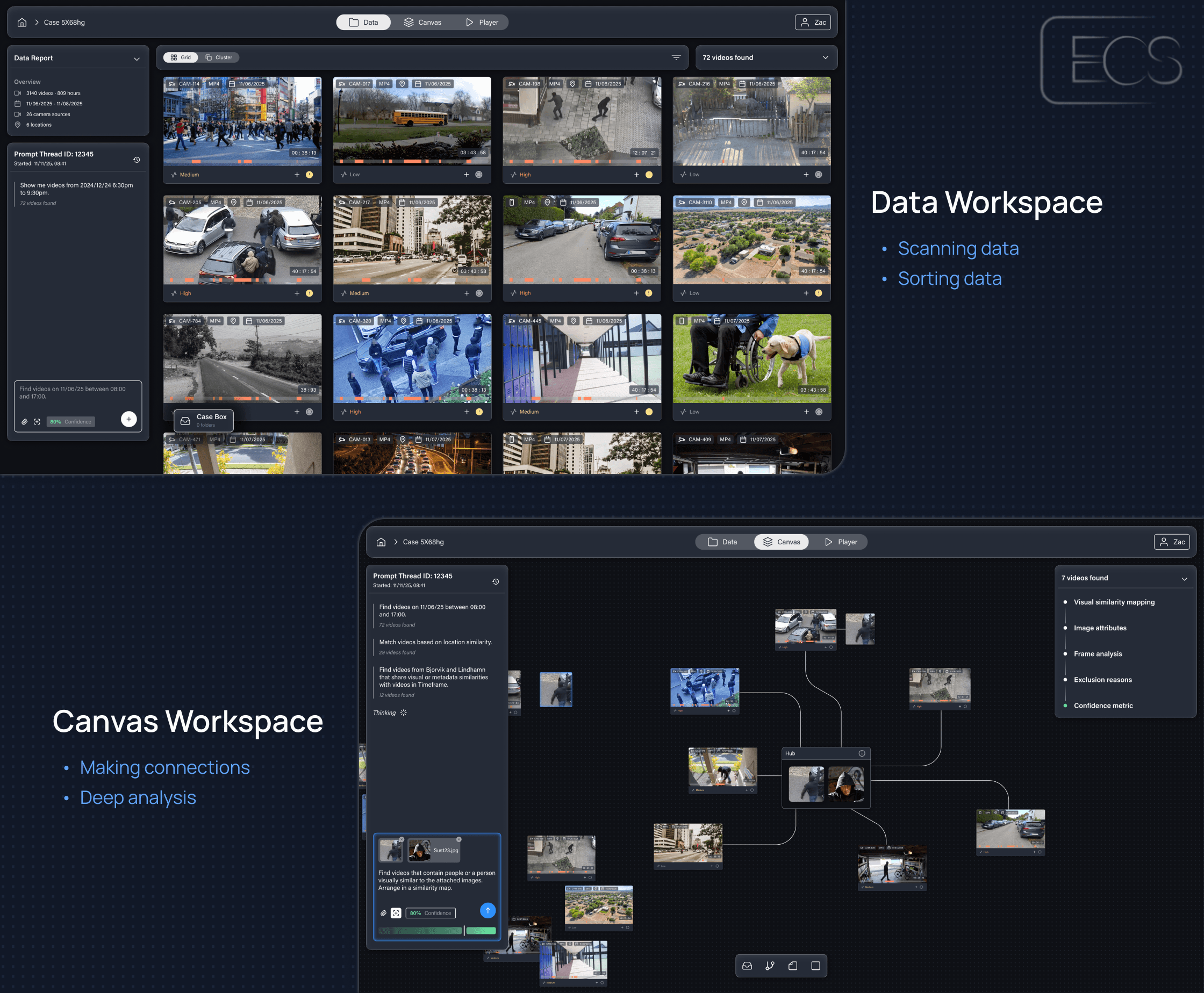
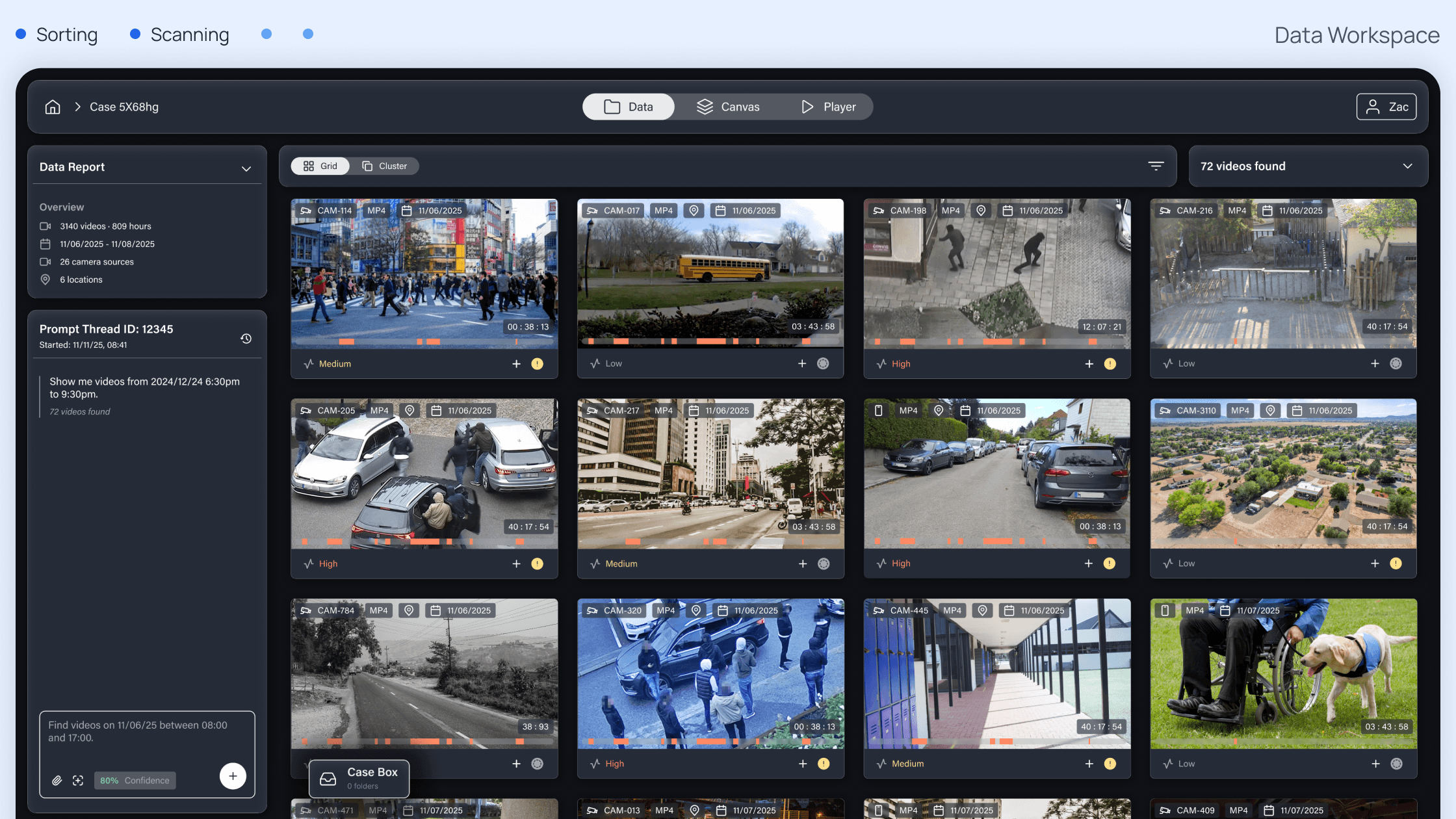
Data Workspace — Overview and Orientation
Investigators trust in data.
But, sorting and contextualising it to find a starting point is time-consuming and cognitively demanding.
The Data Workspace provides a high-level view of large video datasets so that investigators can quickly understand what material exists before committing to deeper analysis.
Key Features:
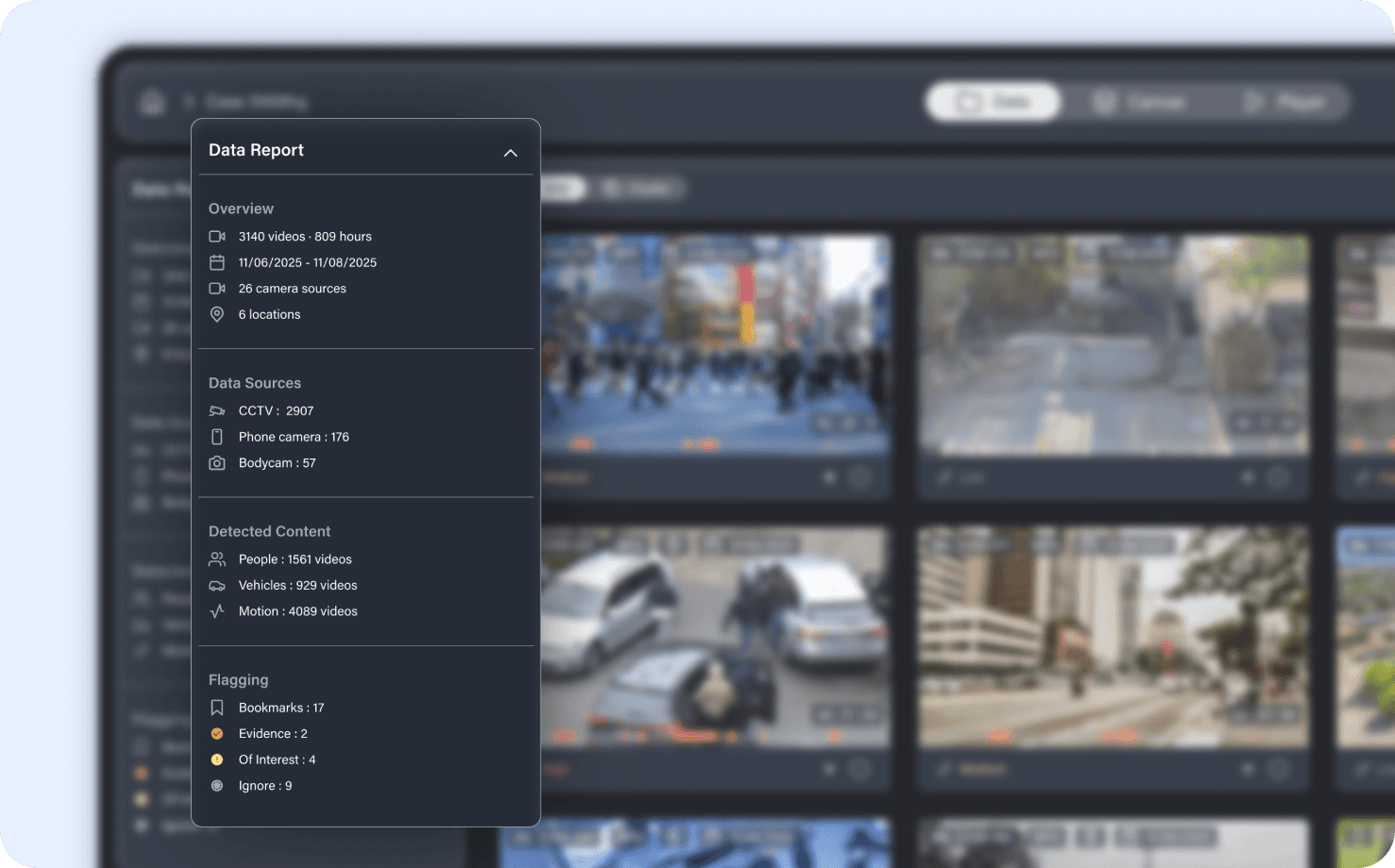
Organising data in one place and providing an overview of the data
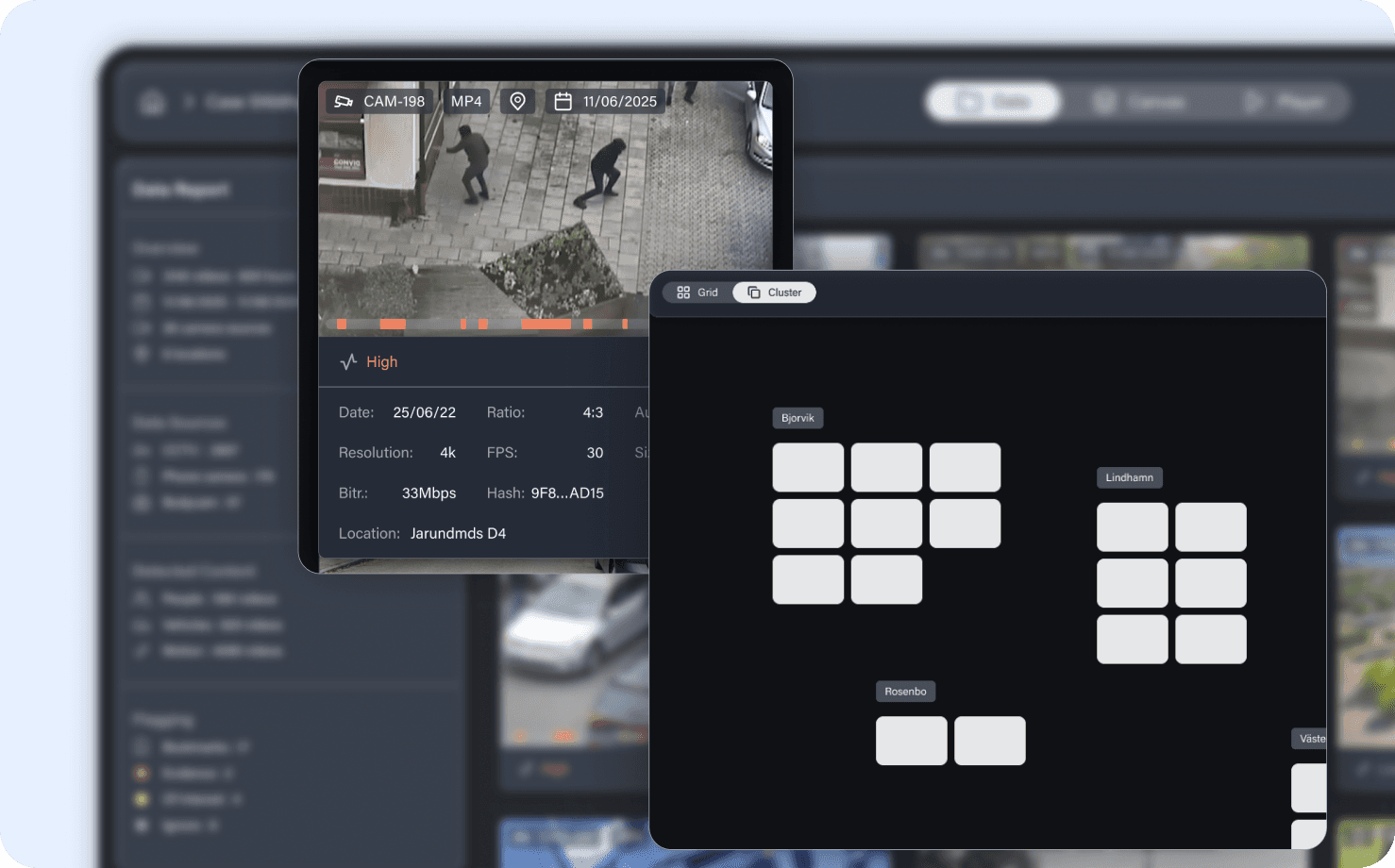
Contextualising data earlier in the process through metadata and data visualisations
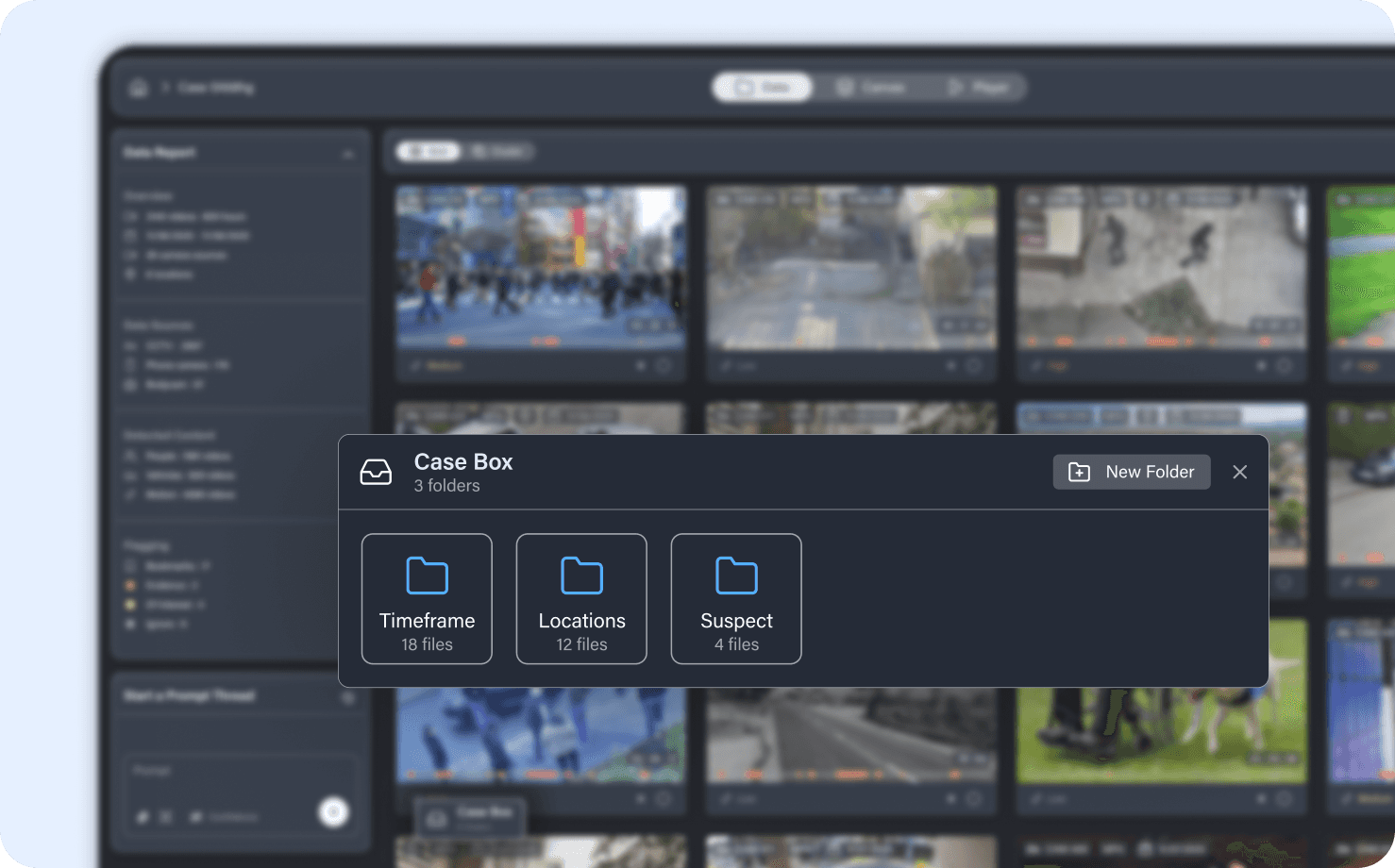
Segregating filtered datasets from the whole
Canvas Workspace — Sensemaking and Analysis
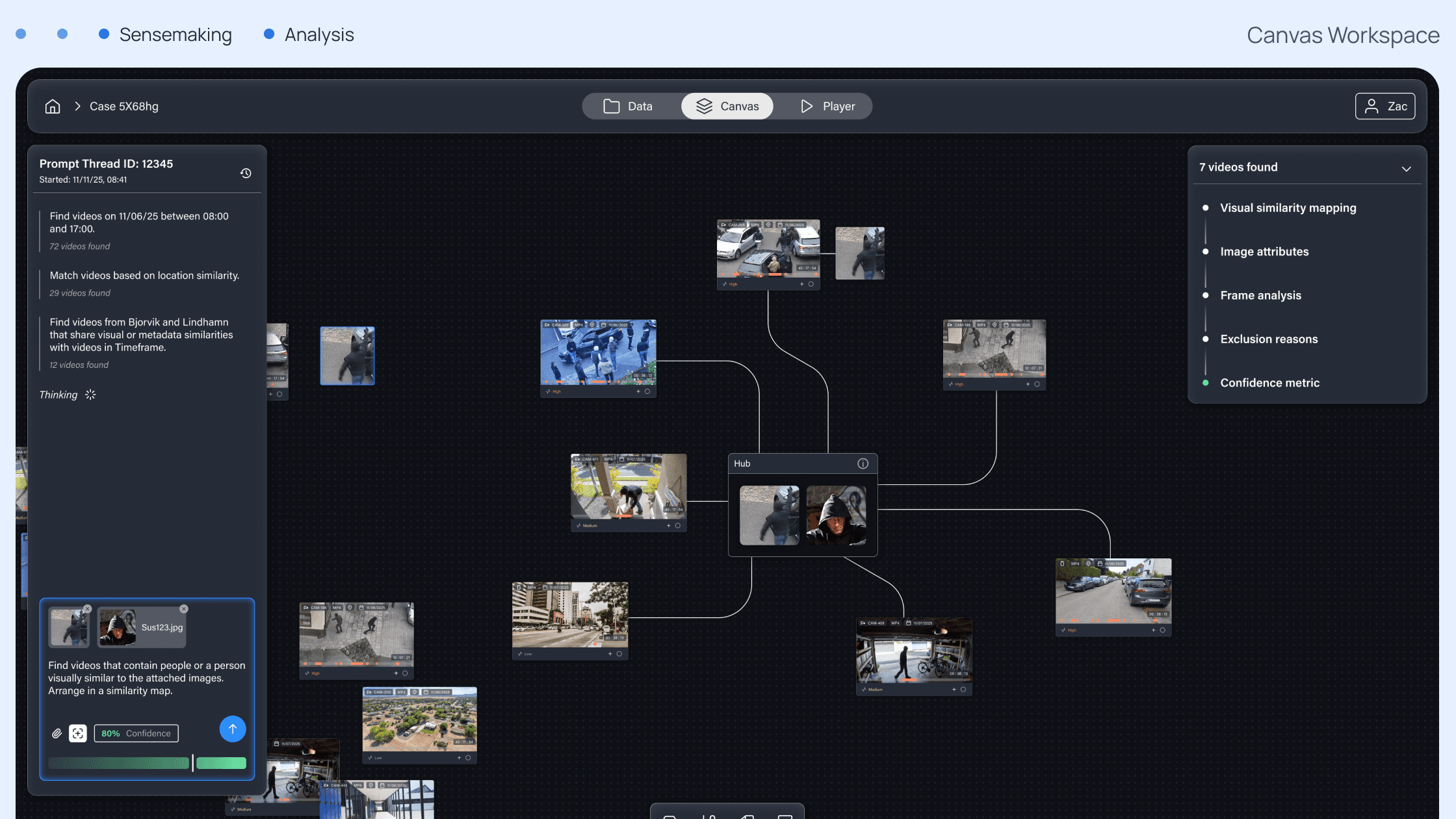
Investigators’ human expertise lies in making connections between data.
But, tools don’t have a space for them to visualise connections between videos.
The Canvas Workspace is a flexible environment for connecting and interpreting evidence.
Key Features:
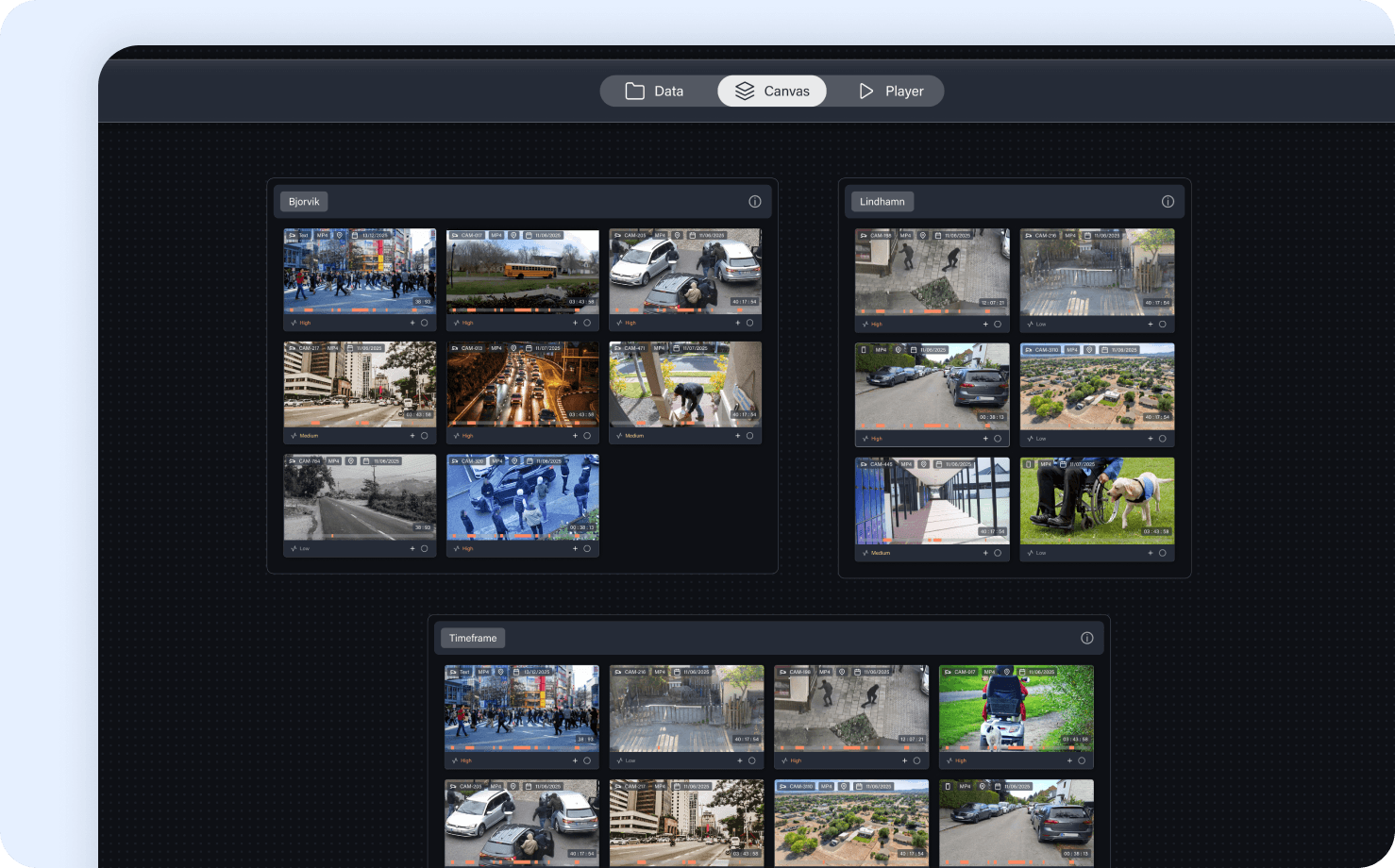
Provide a space for deepdiving into chosen datasets
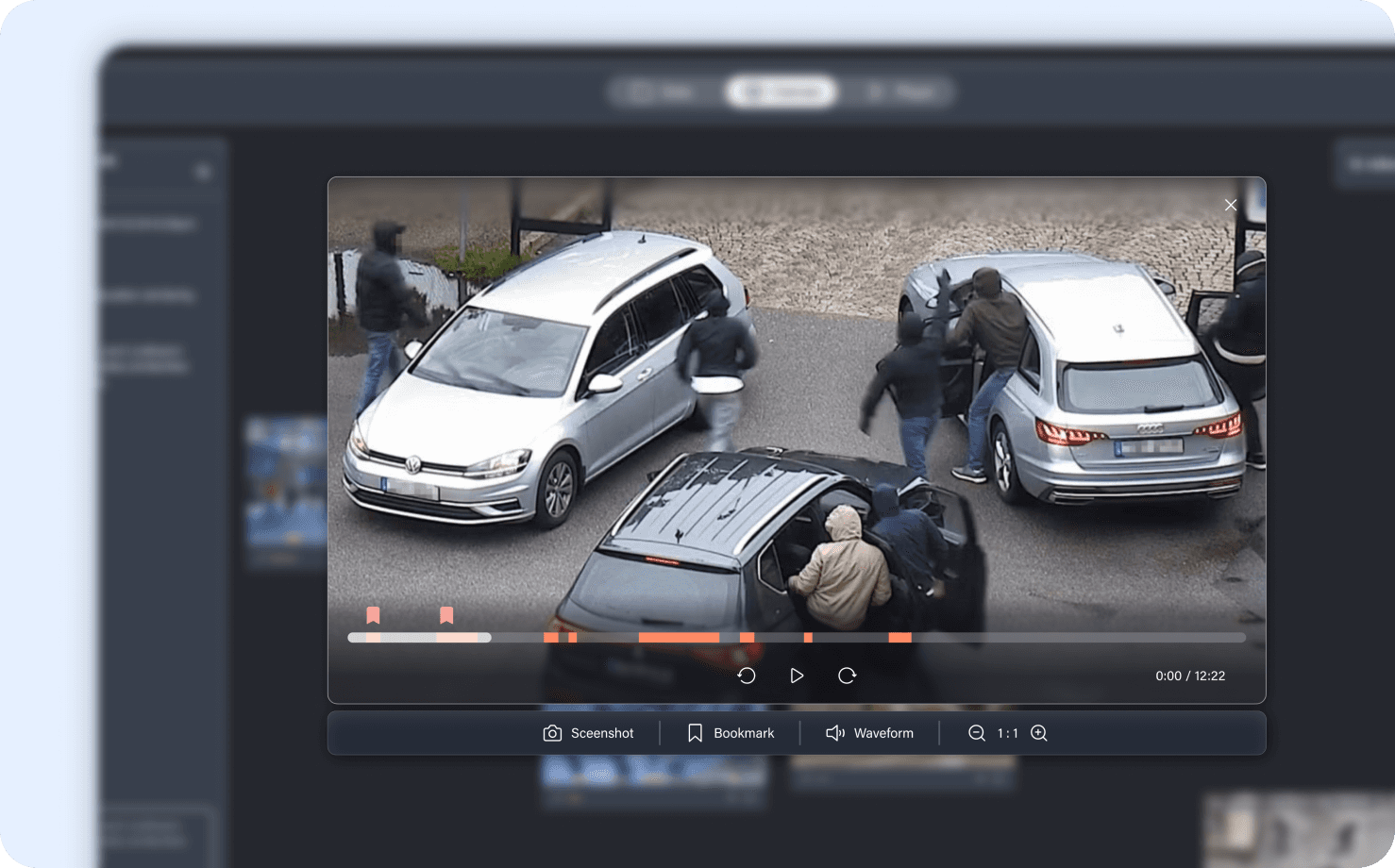
Enabling investigators to review footage in context
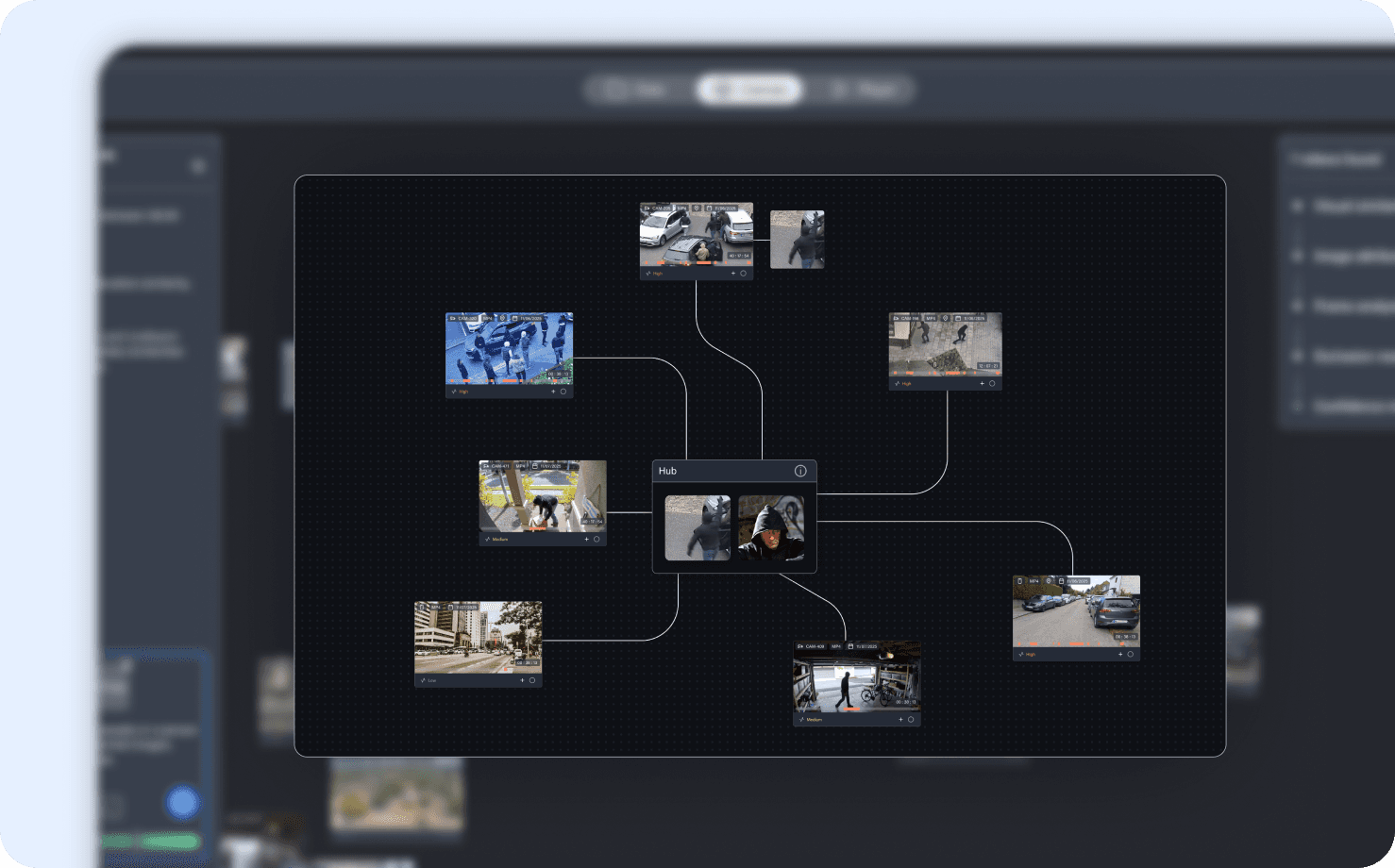
Show relationships between videos through data visualisations
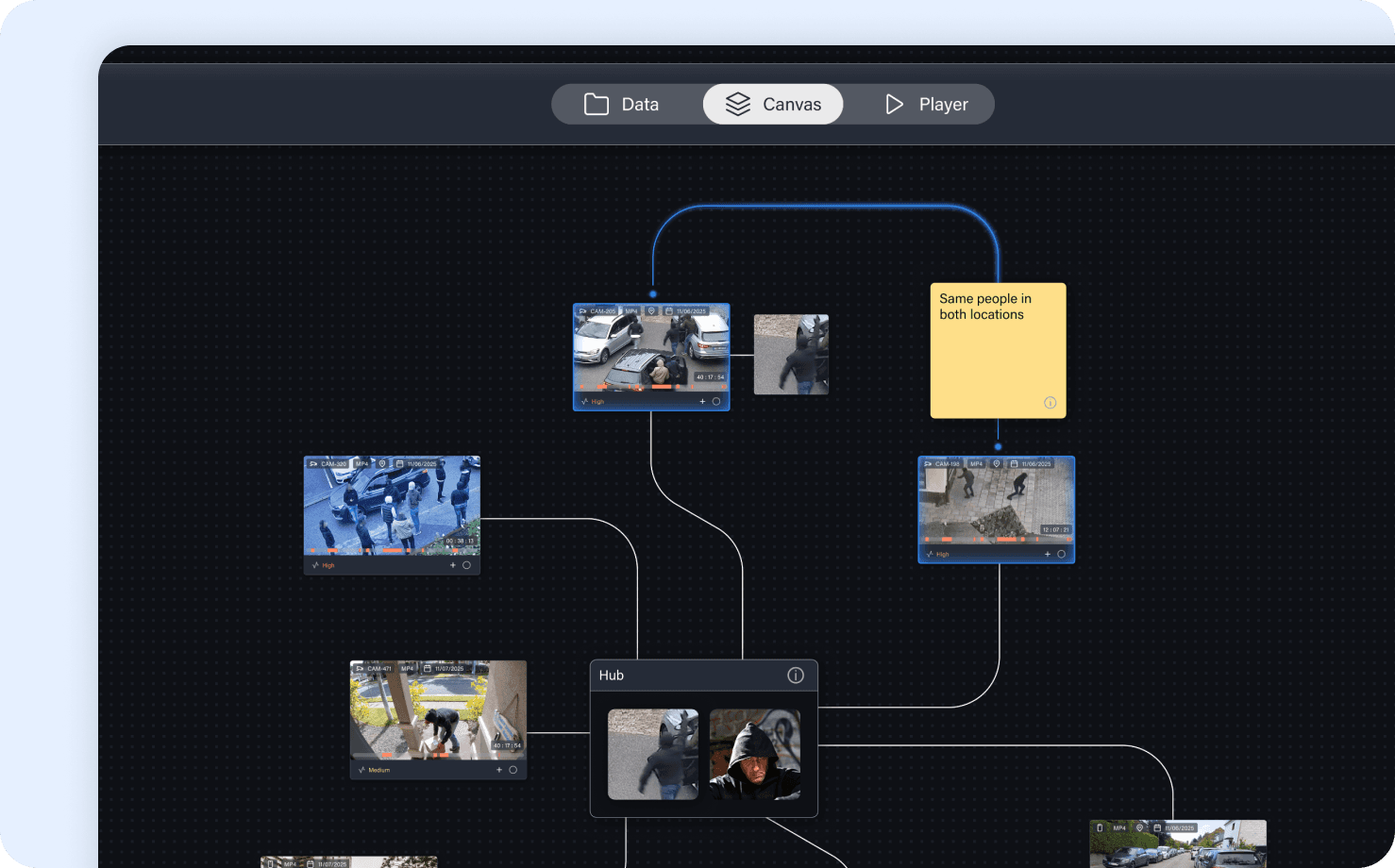
Let users make sense of data for themselves
Prompting — The Read Thread
Investigators interact with the system and its workspaces using multimodal prompts (text, images, video, audio) grounded in their investigative goals.
Rather than acting as one-off commands, prompts form persistent threads that:
Evolve over time
Build on previous results
Can be revisited, refined, and scrutinised across different workspaces
This reinforces trust by keeping investigators actively involved in directing the analysis.
Key Features:
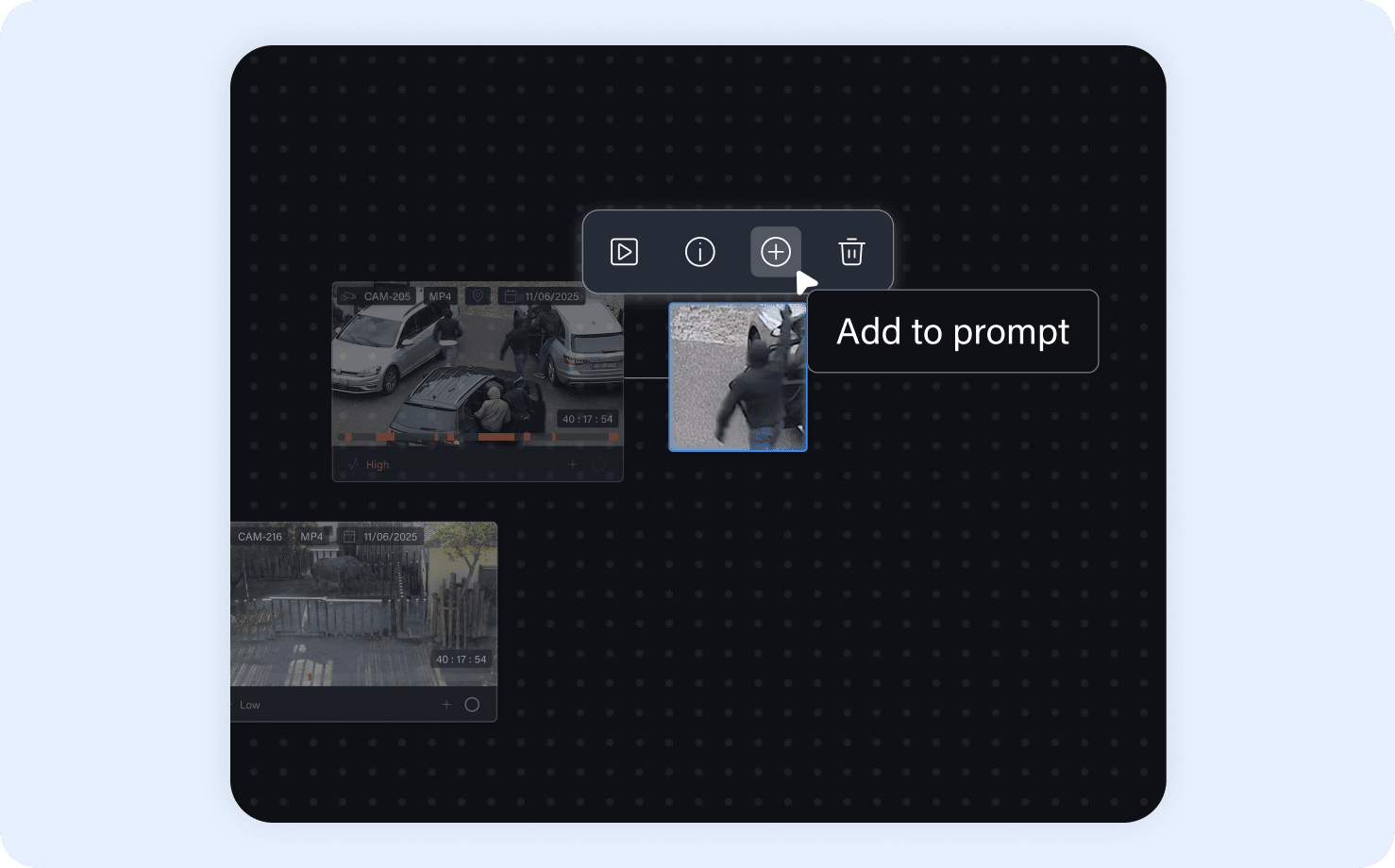
Integrating prompting adaptively within workspaces
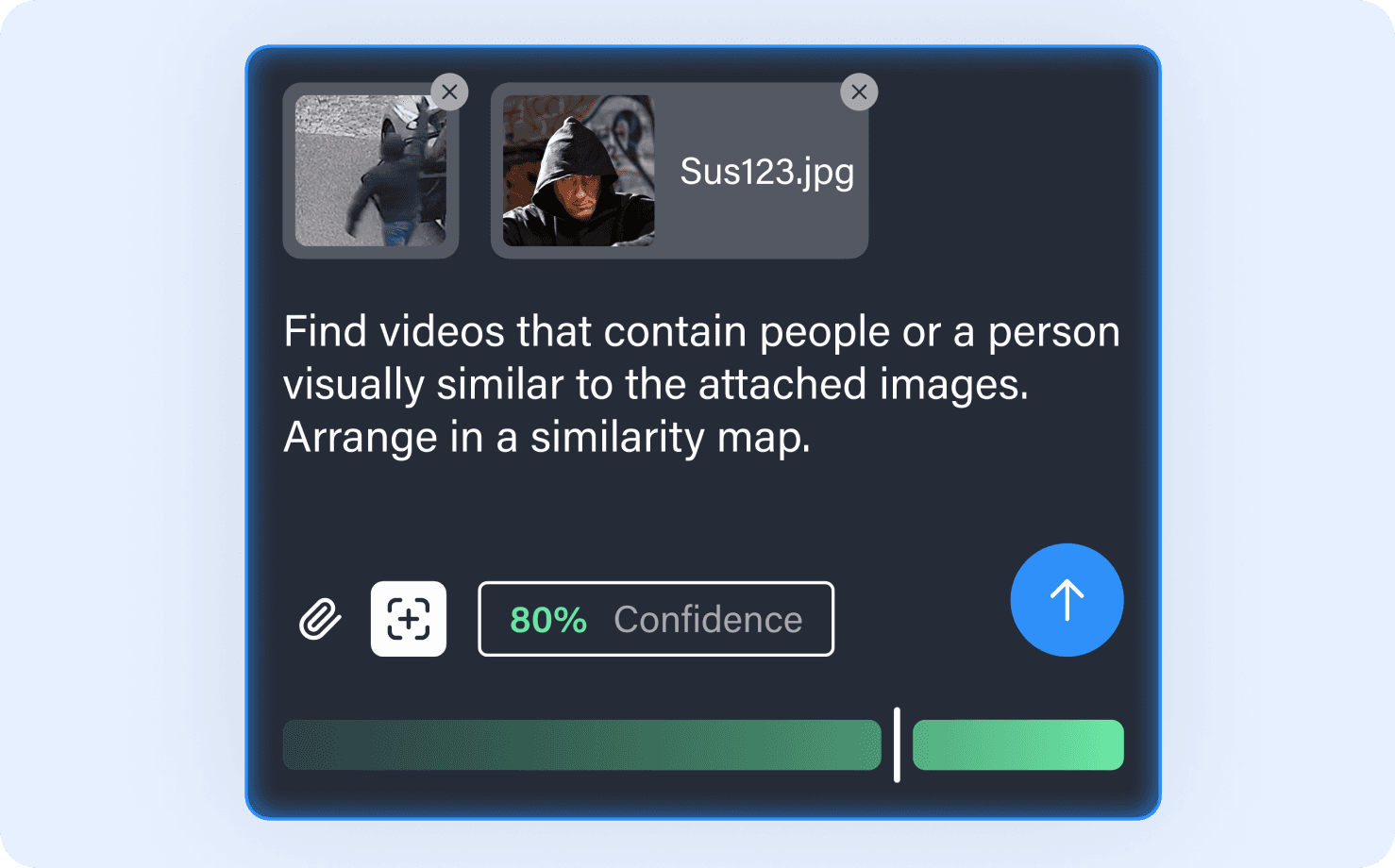
Providing multimodal prompting that can be finetuned
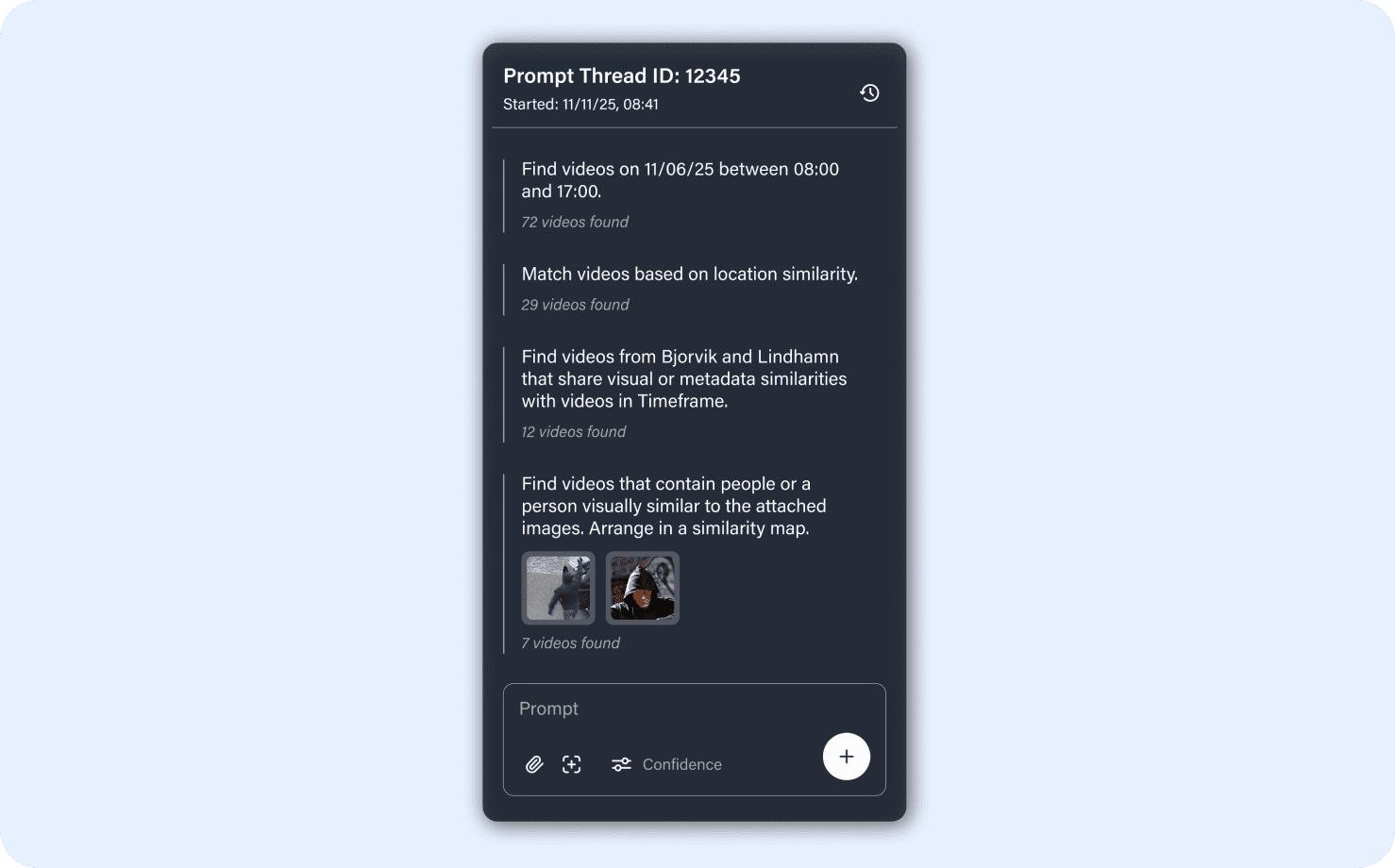
Tracing lines of inquiry with prompt threads
Reasoning Panel — Embodying Explainability
As previously described, explainability is defined as having the qualities of visibility, traceability, and understandability.
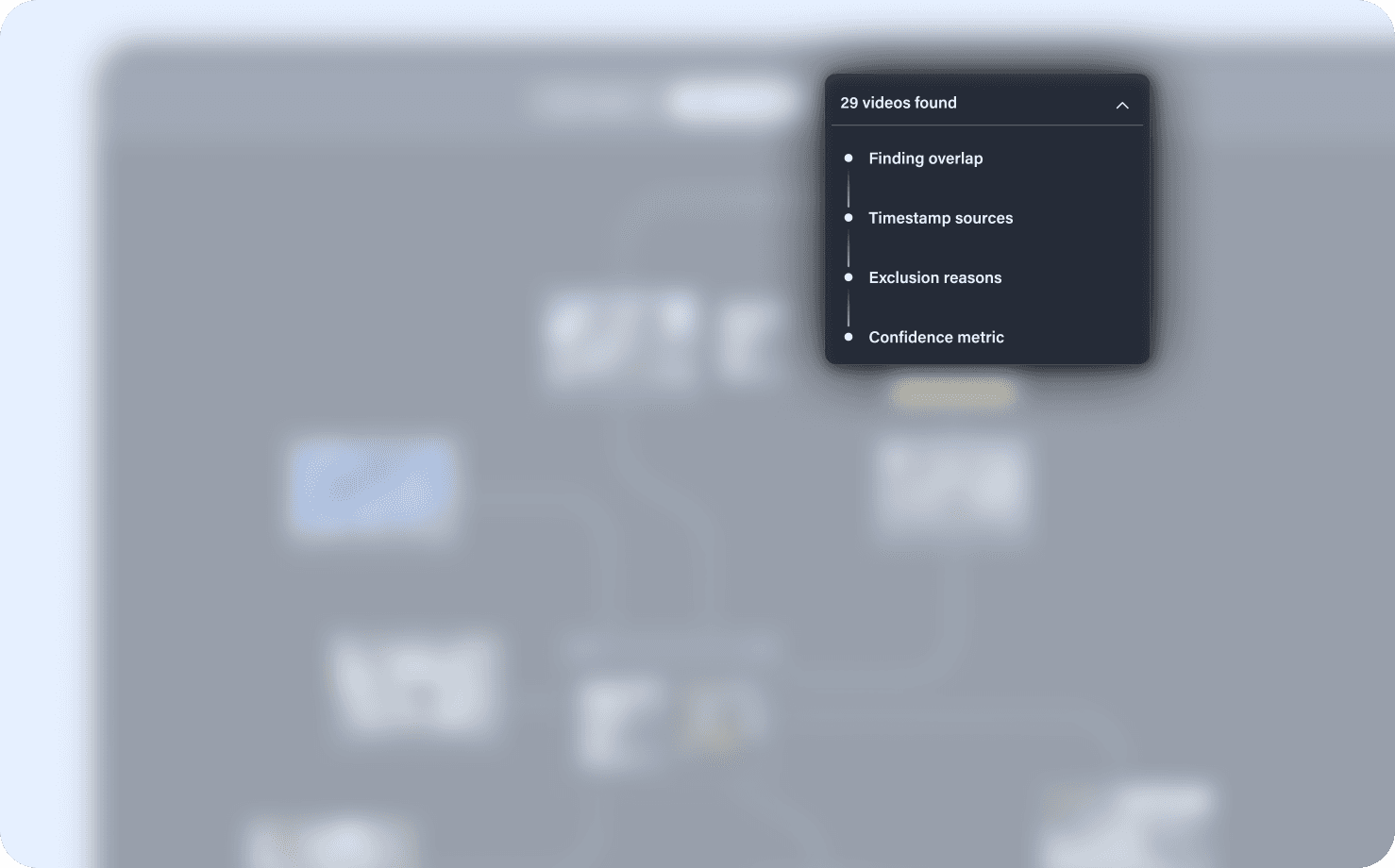
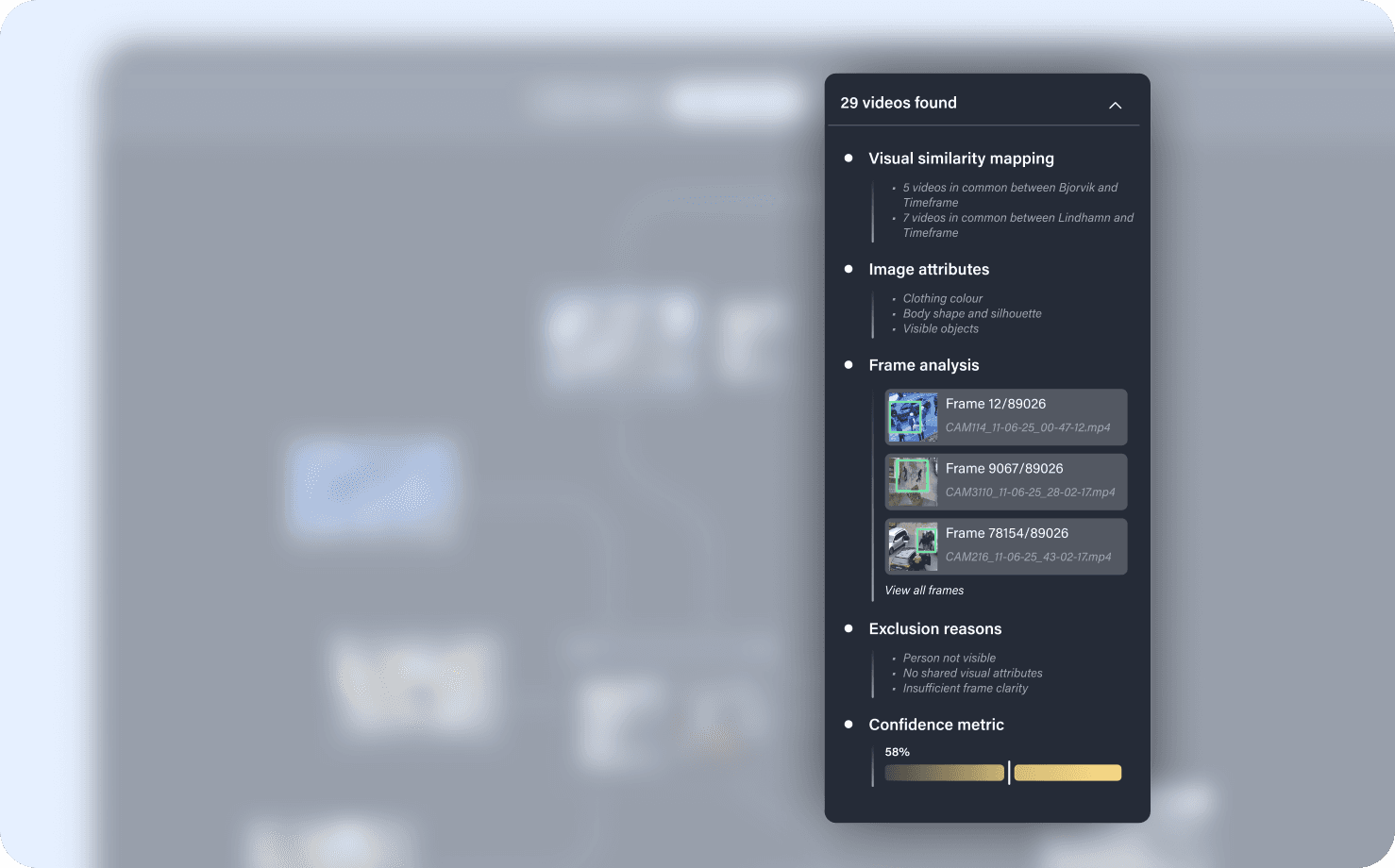
These qualities come together in a reasoning panel that accompanies each prompt, making EOS’s actions explicit and negotiable.
Key Features:
Making the system’s actions
Visible
Making the system’s actions
Traceable
Making the system’s actions
Understandable
Presenting at the Europol Industry & Research Days Conference
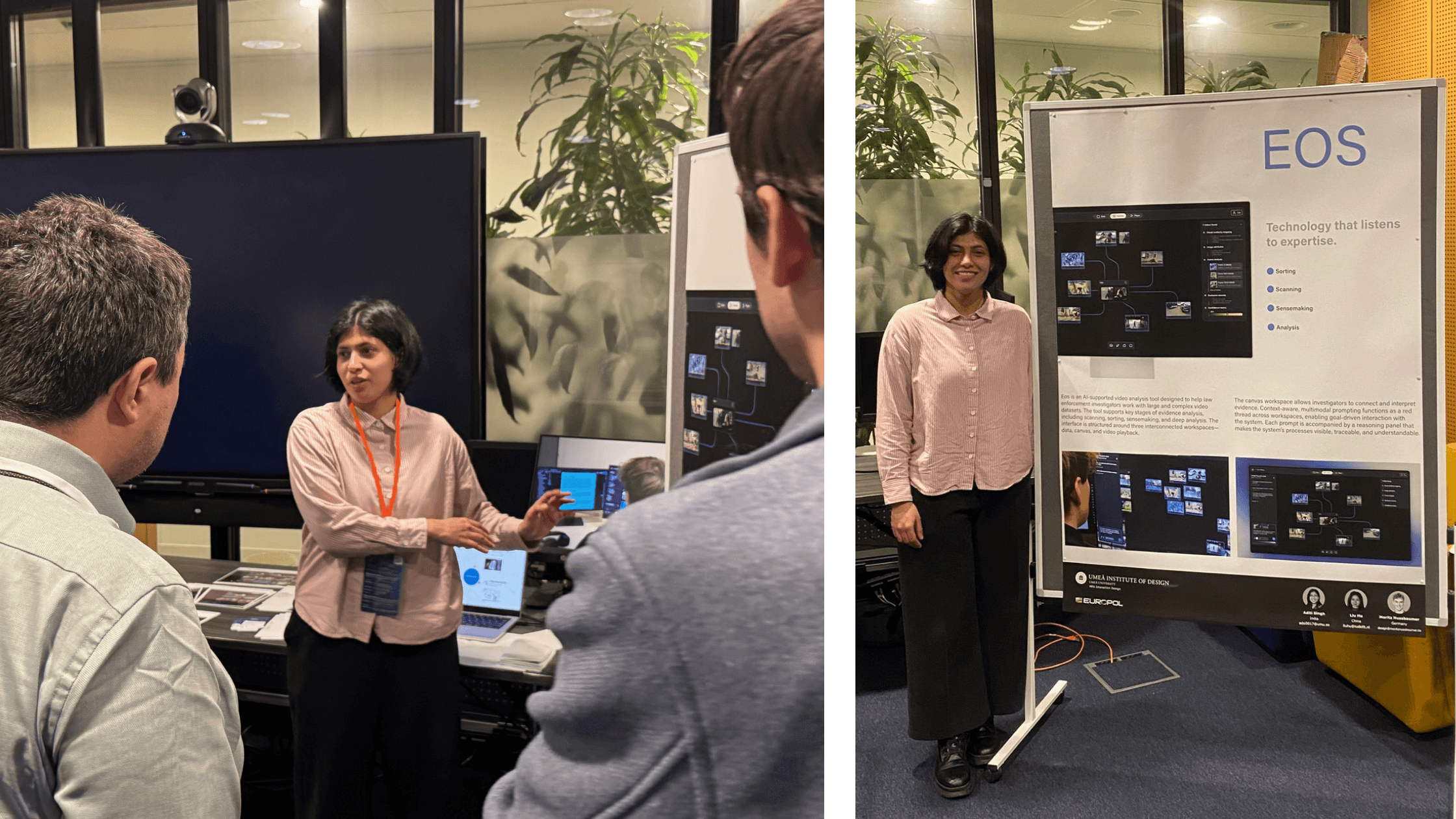
We were invited to Europol’s headquarters in The Hague for the Europol Industry and Research Days conference. We pitched and demonstrated our interface concepts in front of an audience of 200+ professionals, including law enforcement investigators, software developers, and AI specialists. Our design-driven approach to explainable AI in video evidence analysis stood out among the primarily commercial technology presentations.
Reflections
Working on Eos pushed me to think beyond usability and efficiency, and to consider how design choices shape trust in AI-supported systems. I became more aware of the responsibility designers have in high-stakes contexts, where system outputs can influence real-world decisions. This project strengthened my interest in designing AI tools that are transparent, accountable, and supportive of human judgment rather than replacing it.
Presenting at the Europol Industry & Research Days was a valuable opportunity to validate the ideas and intentions behind the project with an audience of professionals experienced in the field. Their receptiveness and enthusiasm were inspiring, and highlighted the relevance of design even for stakeholders outside the design discipline.